
Carolina Frey, Haojun You, Sebastian Kube, Glenn H. Balbus, Kaitlyn Mullin, Scott Oppenheimer, Collin S. Holgate, Tresa M. Pollock (TMS)
AIME Champion H. Mathewson Award in
2026
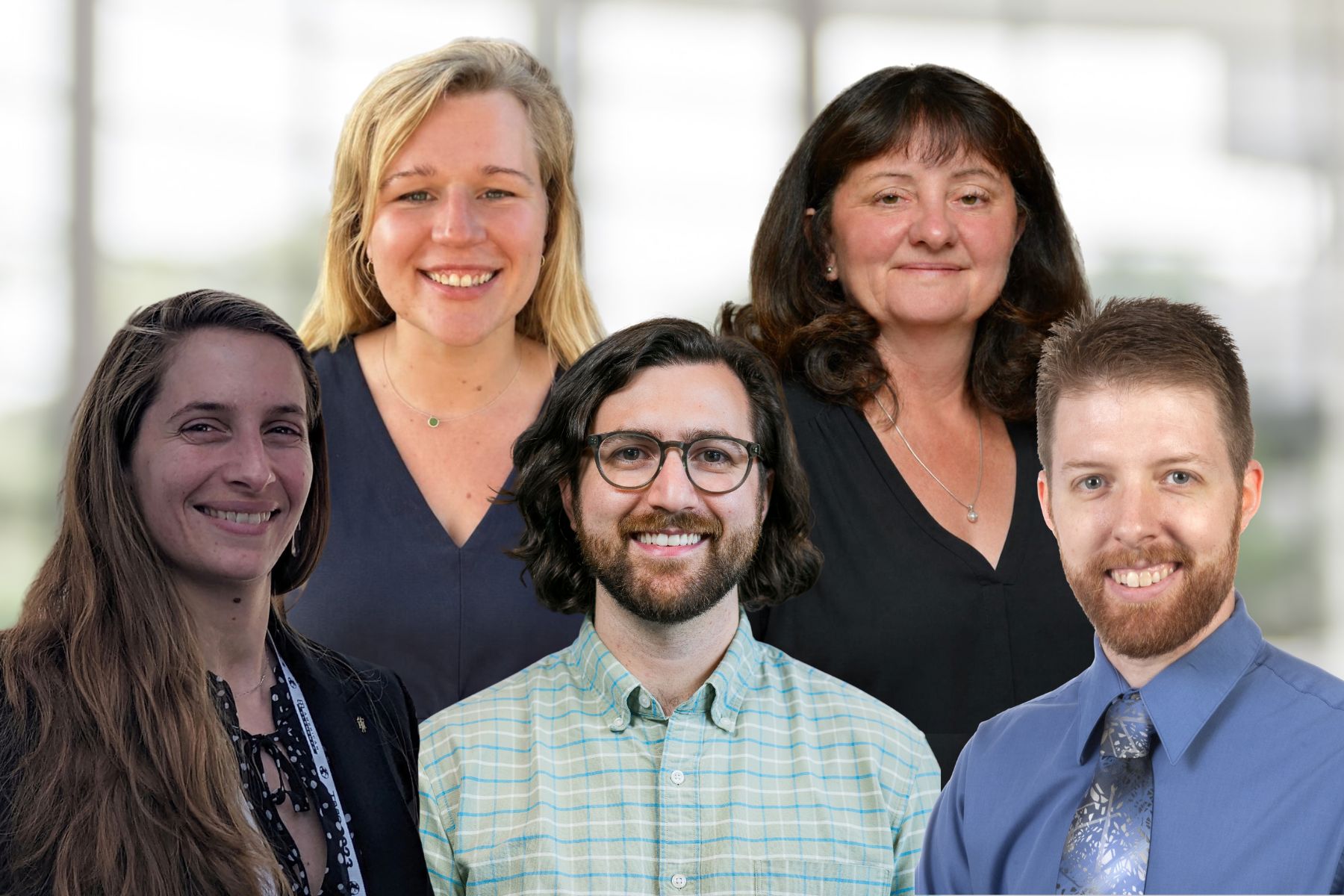
Carolina Frey earned a PhD in Materials Science and Engineering from the University of California, Santa Barbara, where she developed new alloying strategies for niobium-based alloys. She currently works as an R&D metallurgist at ATI, a producer of specialty alloys for the nuclear, medical, and aerospace and defense industries.
Kaitlyn Mullin is a postdoctoral researcher at the Max Planck Institute for Sustainable Materials. She was formerly an NSF Graduate Research Fellow at UC Santa Barbara, where she completed her PhD on the development of refractory alloy design for additive manufacturing under the guidance of Prof. Tresa Pollock.
Dr. Glenn Balbus is a Principal Materials Scientist at Materials Resources, LLC (MRL) and an on-site contractor in the Metallic Materials & Processing group at the Air Force Research Laboratory in the Materials and Manufacturing Directorate. He received his PhD in Materials from the University of California, Santa Barbara, and a B.S. in Mechanical Engineering from Johns Hopkins University. Prior to joining MRL, Dr. Balbus was an Assistant Professor at Lehigh University specializing in Physical Metallurgy and Electron Microscopy and a National Research Council postdoctoral fellow at AFRL. His current research interests leverage in-situ characterization techniques and nanomechanical testing to investigate the role of defects in controlling the properties of metallic alloys, as well as microstructure-processing-property relationships in aerospace materials.
Tresa Pollock is the Alcoa Professor and chair of the Department of Materials at the University of California, Santa Barbara (UCSB). She graduated with a B.S. from Purdue University in 1984 and a Ph.D. from the Massachusetts Institute of Technology in 1989. Pollock was employed at General Electric Aircraft Engines from 1989 to 1991, where she conducted research and development on high-temperature alloys for aircraft turbine engines. She was a professor in the Department of Materials Science and Engineering at Carnegie Mellon University from 1991 to 1999 and the University of Michigan from 2000 to 2010. Her current research focuses on processing and properties of structural materials and coatings and on the use of ultrafast lasers for microfabrication, tomograph, and materials diagnostics. Pollock was elected to the U.S. National Academy of Engineering in 2005, is a 2009 TMS Fellow, a Fellow of ASM International, and was the 2005 President of TMS—the first female to hold that office. Having served as an associate editor since 1997, Pollock was recently named the incoming principal editor for Metallurgical and Materials Transactions family of journals and will begin her editorship in September 2016. She advised the UCSB graduate student organizers of the Transforming the Diversity Landscape symposium held at the TMS 2016 Annual Meeting & Exhibition and was a member of the Panel of Past TMS Presidents during that symposium. She also participated in DMMM1 as an advisory organizer.
Scott Oppenheimer is a metal alloy processing and production specialist who has melted and processed over 3,000 different alloys covering every major alloy system. Scott has experience in porous materials (thesis work at Northwestern), nickel and titanium commercial production (ATI Metals), and a wide variety of nickel, steel, titanium, and refractory alloy development programs (GE Aerospace). Scott is currently the lead of the GE Aerospace global research alloy melting facility in Niskayuna, NY.
Dr. Collin Holgate is a materials scientist whose research has focused on coatings used in energy applications, both in renewables and gas turbine engines. He received his B.S. in Materials Science at the University of Minnesota in 2015. There, he conducted research on spray coating the photovoltaic material copper-zinc-tin-sulfide. He then continued to the University of California, Santa Barbara, where he earned his PhD in 2021 and was advised by Professor Carlos G. Levi. His doctoral research investigated the thermodynamics and kinetics of thermal barrier coating degradation by siliceous debris ingested into gas turbine engines. Collin continued at the University of California, Santa Barbara, for his postdoctoral work with Professors Tresa M. Pollock and Carlos G. Levi. Currently, his research specializes in the design of high-temperature structural alloys, their synthesis, and their characterization.